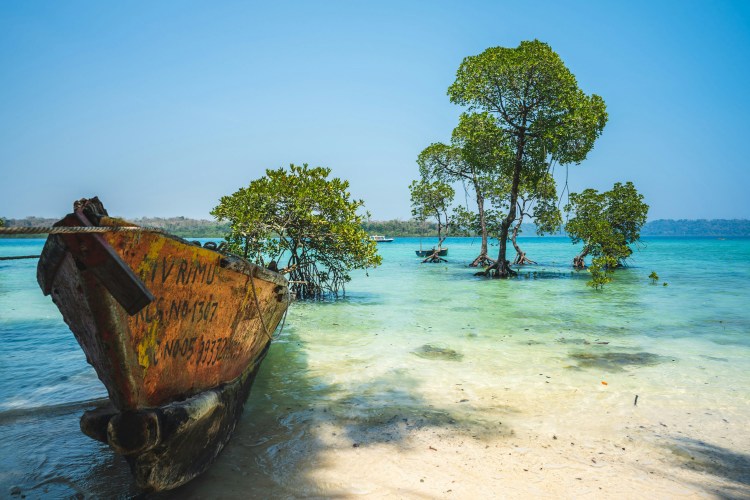
by Uygar Özesmi (2005) Photo by tatonomusic on Unsplash
Emerging from among the coconut trees, he hurried towards his canoe to catch today’s fish. But just as he was about to set sail, he felt the wind blowing against him. Unlike the usual morning breeze that would aid their departure, the wind blew towards the shore. The waterline was higher than normal, and the oar felt heavier. He looked up, searching for seabirds in the sky, but instead of finding them hovering over the sea at this hour, his eyes found them behind, over the forest. He remembered the ceremonial song…
The sea surged, the wind fled in haste,
Stubborn rowers sailed, facing death’s taste.
Giant waves chased by the wind’s fierce breath,
While wiser gulls escaped unscathed from death.
The waves engulfed our people’s fate,
But those who watched the gulls did not abate.
He swiftly pulled his canoe out of the water, dragging it onto the shore and securing it tightly to a sturdy tree. Running along the coastline to spread the word, he found no need to persuade anyone; all the fishermen were already busy securing their own canoes. Gathering their bows and arrows, their families in tow, they hurried deep into the heart of the island. A couple of hours later, as the distant rumbling grew nearer, they gathered together and quietly sang their songs…
Forces of Mother Nature
Made Father Sea roar
Mangroves took flight
Pruned, they spread wide
Finding new islands
Life blooms anew
On December 26, 2004, massive waves, known as tsunamis, struck the shores following an earthquake in the Indian Ocean, resulting in the loss of over 200,000 lives and leaving millions homeless. However, the indigenous people living on the Andaman Islands near the epicenter did not suffer any casualties. The Jarawa, Onge, Shompen, and Sentinelese tribes safely weathered the tsunami. These tribes settled on the islands during the ancient and middle Stone Ages, between 60,000 and 20,000 years ago. In contrast, the Nicobar tribe, which settled during the New Stone Age, 7,000 to 5,000 years ago, lost some of its members.
While the tribes easily survived the tsunami, they were severely affected by modernity and its methods. When they first encountered British colonizers in 1789, diseases, wars, opium, and concentration camps led to the loss of over 90% of their population. In 2005, approximately 270 Jarawa, 100 Onge, 200 Shompen, and 50-150 Sentinelese remained. Despite the relatively more sensitive approach of the Indian government, the threat of extinction persists due to “development” policies. Stubborn rowers have filled the indigenous people into their large boat dominated by modern worldviews and are rowing vigorously against the wind.
Were the over 200,000 casualties of the 2004 tsunami victims of the massive waves or the absence of an early warning system? Similar questions were raised after the August 17, 1999, Marmara earthquake in Türkiye. That earthquake claimed over 25,000 lives. Were the casualties victims of the earthquake or improper construction methods and settlement policies? I always approach such questions with skepticism because both answers and what is deemed important are embedded within the problem. The solution presented to us lies in the application of modern technologies; what matters is not just the deceased but also those whose lives have been overturned. Perhaps what is important is not just being informed in time, nor correct construction and settlement policies, but our approach to development and our relationship with nature. It is not enough to learn from every disaster; we must also learn the right lessons. The lesson we need to learn may be to stop obstinately rowing against the wind and instead listen to the rhythms and workings of nature.
We share the same fate as the indigenous people of the Andaman and Nicobar Islands. We, the modern people of the modern age, have filled the boat of modern worldviews and are rowing against the wind. Coastal mangroves, which protect against storms and waves and host rich biological diversity as breeding grounds and sources of food for fish, have been uprooted, coastal forests have been cut down, and coastlines have been plundered. They have been filled with hotels, marinas, and ports; cities and villages have descended into plains, and natural materials have been replaced by concrete. There is no longer vegetation to hold back the giant waves, and the raging waters have advanced inland, wreaking havoc on everything.
What remains of the mangroves and forests after the “development” massacre has held back the waves, protecting what’s behind them, but in doing so, they’ve been pruned, shrunk, and sometimes disappeared. The shoots carried by the waves will not find a place to grow and thrive anew. Turtles, lizards, mammals, and birds swept away by the waves and winds will not find branches to cling to and forests to breed in on the new islands they reach. We have halted evolution and cut off the necessary biological diversity for the islands to find new life. And we are already destroying what exists. While we cut the branch we are sitting on, our saws are: satellites monitoring the ocean, early warning systems warning “take cover, leave everything behind,” bulldozers, ships, hotels, sea-view villas and apartments filling every space, and an ever-increasing number of people. What will we lose in the next “natural disaster,” what else will disappear?
It is time to stop stubbornly rowing against the wind and allow nature to fulfill its existence. We must halt the concreteization of the remaining coasts and allow the coastal vegetation to revive. Natural processes may be restored if all natural areas freed from “development” are preserved. To achieve this, we must first reorganize our livelihoods and lifestyles and focus on economic activities in harmony, in symbiosis with nature. To allow nature to fulfill its existence, we must put an end to permanent structures like factories and hotels in major disaster areas and only build the most necessary structures resilient to such disasters. Let’s put the eco of ecology, not that of economy, ahead of all our activities, including tourism, agriculture, and construction.
Then, when we have the wind at our backs, we will pull the oars with joy into the waters teeming with thousands of fish…
Translated from, Özesmi, Uygar (2010). Yasak Meyve : Cehennemden Çıkış, TB Yayıncılık, İstanbul, 196 Sayfa, ISBN 9786055745066
 uygarca